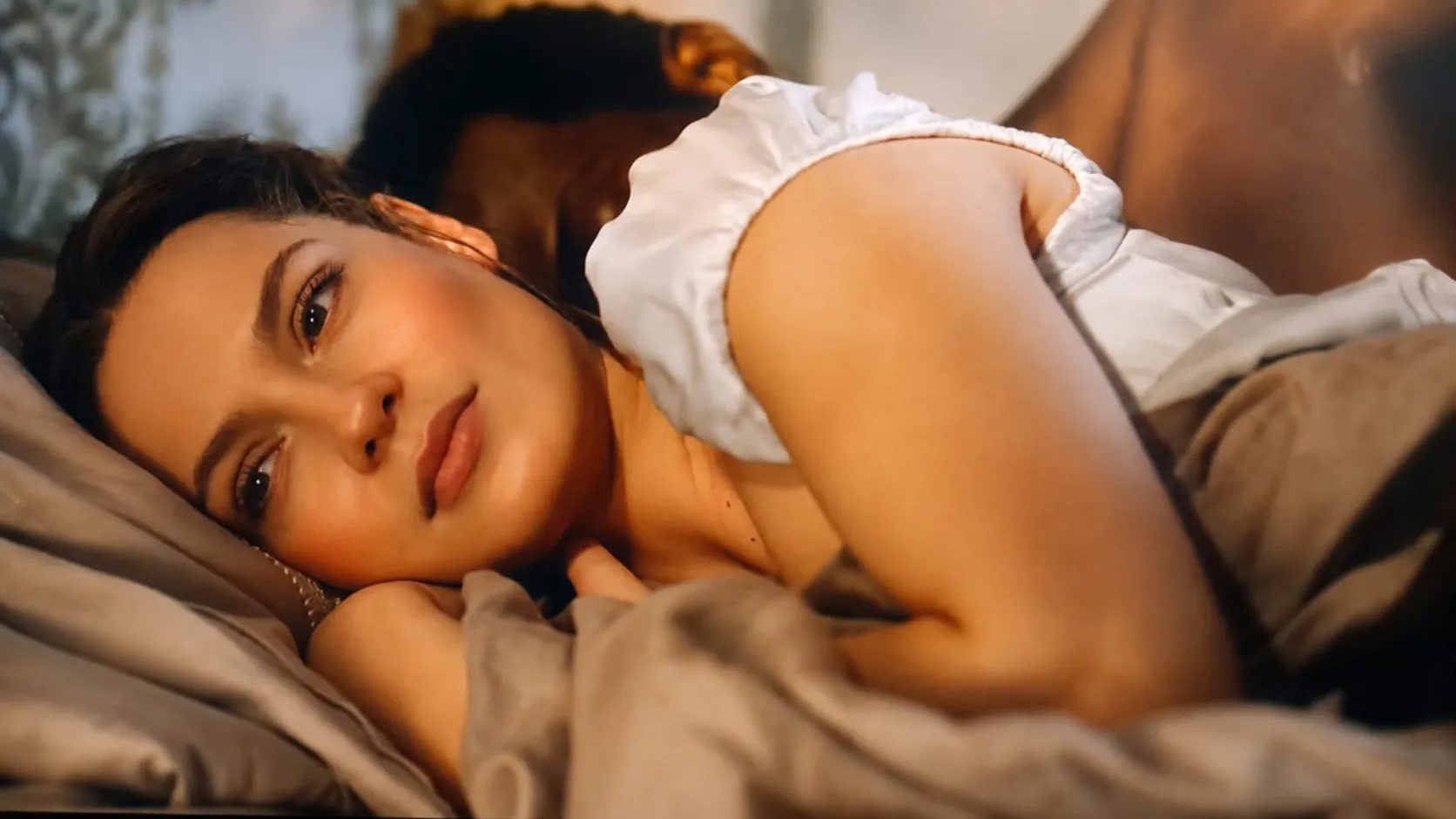
If you've watched Season 4, Episode 3, you know the scene.
Francesca Bridgerton — composed, intelligent, newly married — lies in bed with her husband... confused. Not heartbroken. Not traumatised. Just quietly, unmistakably underwhelmed. She asks him if it's unusual that they haven't conceived a child yet, and whether there's something she should have been doing differently. He tells her that a woman is more likely to conceive if she achieves her "pinnacle." And when he asks if she's been achieving hers, she lies — "Of course, yes." But Francesca and John have struggled to connect in bed, and the truth is, she has never had an orgasm. You can see it on her face: Is that it? Was that the pinnacle everyone talks about?
And the internet lost its mind. Not because it was shocking — but because it was familiar. Millions of women watched that scene and thought the same thing: That was me.
Not in a Regency-era bedroom with an earl. But in a regular bedroom, with a real partner, wondering why the thing everyone made such a big deal about felt like... nothing much.
Bridgerton didn't invent this conversation. But it said it out loud, in front of millions of people, in a way that finally made women feel seen. And that matters — because this silence has been going on for far too long.
Why that scene hit so hard
Francesca's confusion wasn't played for comedy. It wasn't dramatic. It was quiet and honest — which is exactly why it resonated.
Because the truth is, most women's first sexual experiences don't end with fireworks. They end with a version of Francesca's face: Was that supposed to feel good? Did I do something wrong? Is something wrong with me?
And instead of talking about it — instead of asking questions or seeking answers — most of us just went quiet. Because we were never taught that our pleasure was something worth pursuing in the first place.
The education we never got
Think about what you were actually taught about sex. If you grew up like me — in a conservative culture, in a household where sex wasn't discussed — the education was basically this:
Don't do it. And if you do, don't get pregnant.
No one talked about pleasure. No one talked about what feels good. No one mentioned the word orgasm in the same room as a woman. The entire conversation was built around risk and shame — not around understanding your own body.
And even in more progressive settings, sex education focuses on biology. Reproduction. Protection. The mechanics of it. But nobody sits you down and says: "Here's how your body actually works. Here's what pleasure looks like for you. Here's why it might take time to figure out. And here's why that's completely normal."
So we entered our first sexual experiences with no map, no language, and no permission to ask for more.
Growing up, I never heard a word from my parents about sex. Not one conversation. And when I had my first sexual experience, I never told them — because losing your virginity before marriage was a sin.
My parents told me you could only kiss a man if you were married to him. So when I was about five or six, I saw a couple kissing on my grandparents' property — they were renting there at the time — and I asked my mum why they were kissing if they weren't married. (I knew they weren't married because they looked like they were in their twenties.) And my mum just told me not to do it. Only married people kiss.
So when I lost my virginity to a man who wasn't even my boyfriend, it felt like I was losing my mind. I genuinely believed that because he was the one who took my virginity, he was supposed to be the one I married. But life doesn't work that way — and that was a brutal lesson to learn. I talked about this more in Why Moving On From Your First Sexual Partner Is So Hard.
My version of the Francesca moment
I watched that scene and felt something unlock inside me. Because I'd been there. Not in the same way — but in the same feeling.
If you ask me when I realised sex wasn't what I expected — it was the first time. When I lost my virginity.
It was confusing. I could tell he was enjoying it — the way he moved, the way he responded. But for me? I just felt the physical sensation and nothing else. No pleasure. No build-up. No moment where I thought "oh, so this is what everyone's been talking about." I was just there. Present but disconnected. Smiling. Going with the flow. Not knowing what I was supposed to be feeling — or if I was supposed to be feeling anything at all. Exactly like Francesca's face in that scene.
And when it was over, the only thought in my head was: Is that it? Is that what it's supposed to feel like? Francesca's face was literally my face. We cleaned up, got back into bed, and he fell asleep — while I lay there, wide awake, trying to understand what had just happened.
The worst part wasn't the experience itself. It was the silence afterwards. Because I didn't know who to talk to. I didn't know if what I felt — or didn't feel — was normal. And I definitely didn't know that the problem wasn't me. It was never me.
What nobody tells you
Your first time is almost never "the pinnacle." Movies, TV, romance novels — they all sell this idea that sex is instantly magical. For most women, the first time is awkward, uncomfortable, and confusing. The sooner we normalise that, the less shame women carry into their sexual lives.
Orgasm is learned, not automatic. Most women don't orgasm from penetration alone. It's just how most women's bodies work — but nobody teaches us that. So we spend years thinking something is wrong with us, when really, we just haven't been given the information or the space to figure out what works.
Your pleasure is not a bonus. Not secondary. Not optional. Not something that happens if there's time left over. Your pleasure matters as much as your partner's. Full stop. And any partner who doesn't understand that isn't the right partner.
It gets better — but only if you participate. This is the part Francesca's story is building towards. It gets better when you learn about your own body. When you communicate. When you stop performing and start being honest. When you find a partner who cares about your experience, not just their own.
What Bridgerton got right
The reason that scene matters isn't just because it showed a woman not reaching orgasm. It's because it showed her not knowing that she could. Not the failed pinnacle itself — but the fact that nobody ever told her it existed in the first place.
And that's the reality for so many women. Not just in the 1800s. Right now.
We grow up in cultures that teach us sex is something that happens to us, not something we actively participate in. Something we endure, not enjoy. Something for him, not for us. And by the time we realise that's a lie, we've already spent years in silence — years of faking, years of confusion, years of thinking our bodies are broken.
They were never broken — just never given the manual.
Where to start if this is you
If you watched that scene and thought "that's me" — here's what I'd say:
Start with yourself. Before you can tell a partner what you want, you need to know. Exploring your own body isn't shameful — it's essential. It's how you learn your own language so you can teach someone else to speak it.
Read. Not romance novels — actual resources. Come As You Are by Emily Nagoski is the book I wish someone had given me at eighteen. It explains how women's bodies actually work — not the biology textbook version, but the real version.
Talk to your partner. If you're with someone, have the conversation. It will be awkward. It will be vulnerable. But it will change everything. (I wrote a whole post about how to have that conversation if you need a place to start.)
Stop performing. This is the hardest one. Stop faking. Stop prioritising their experience over yours. Stop pretending it was good when it wasn't. Your honesty isn't rejection — it's an invitation for something real.
Give yourself time. You're undoing years of silence, shame, and miseducation. That doesn't get fixed in one conversation or one night. Be patient with yourself. The fact that you're even thinking about it means you're already further along than you think.
The conversation Bridgerton started
Francesca's story isn't just entertainment. It's a mirror. And for millions of women who watched it and felt something they couldn't name — it's permission.
Permission to say: I didn't know. Permission to say: Nobody taught me. Permission to say: I deserve more than what I've been settling for.
And it's about time someone said it — in a world that's been whispering it for centuries.
If you watched that scene and felt seen — you're not alone. And if you're still figuring it out? So are the rest of us. Not something to be ashamed of. Something to talk about.



Comments 0