There's a specific kind of homesickness that lives in your stomach.
It's not the dramatic kind — it's not crying at the airport or missing your family on Christmas (although, yes, that too). It's the quiet kind. The kind that hits you on a random Tuesday night when you're staring into your fridge and realising that nothing in there will taste like home. You've got pasta. You've got sauce. You've got whatever sad vegetable is still surviving from last week's grocery run. But none of it is it.
If you're Filipino and living in Australia, you know exactly what I mean. You can eat well here — the food is great. But there are days when your body doesn't want great. It wants sinigang. It wants something your lola would recognise. It wants the taste of the kitchen you grew up in.
The good news? You can build that kitchen here. Thankfully, there are Asian grocery stores in most Australian cities where you can find almost everything you need. And once you stock your pantry with the right essentials, a craving doesn't have to stay a craving — it can be dinner in thirty minutes.
Here's the checklist I wish someone had given me when I first moved.
The essentials (a.k.a. the non-negotiables)
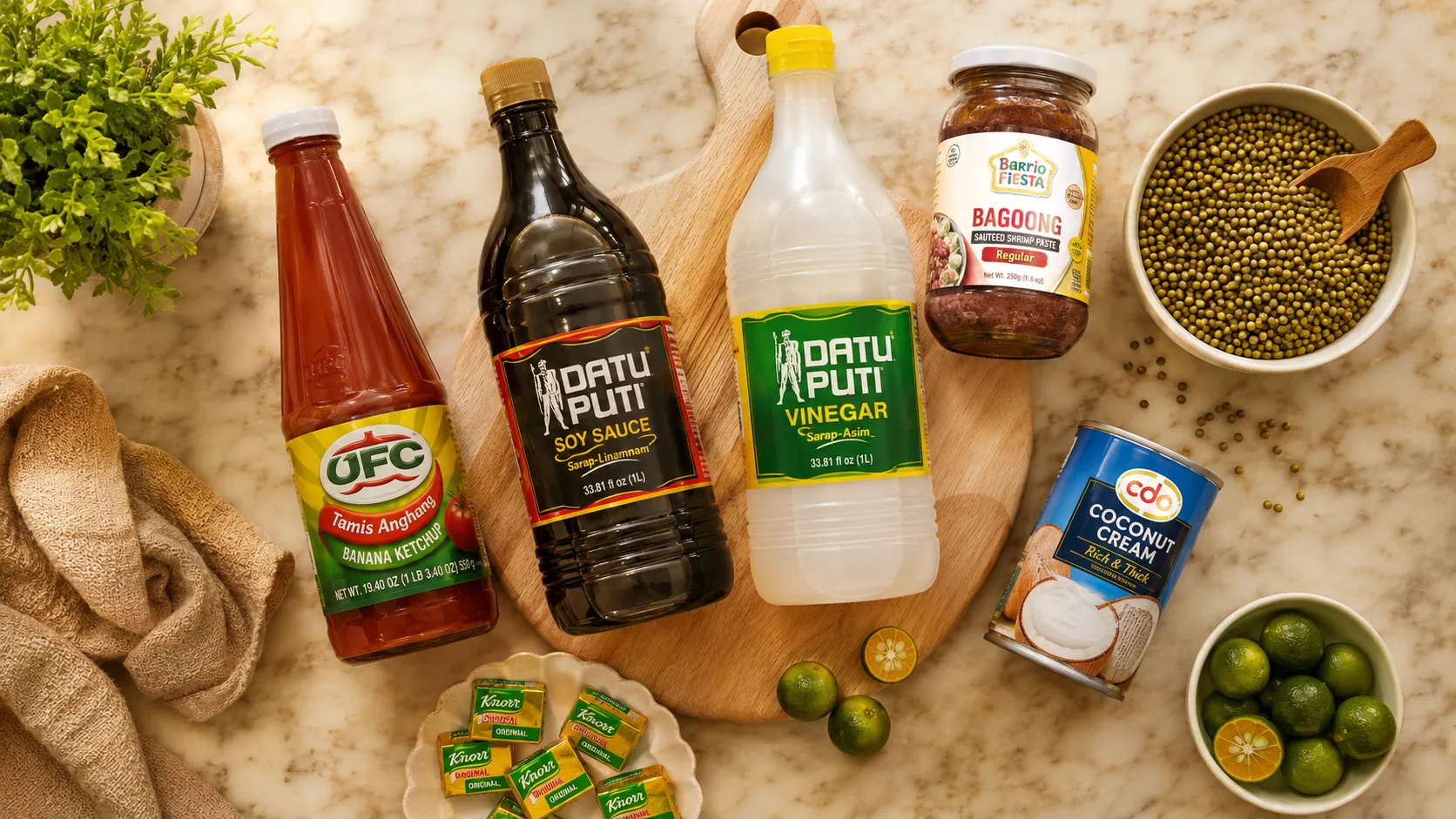
1. Calamansi — This is number one. No debate. Fresh is hard to find, but most Asian stores carry calamansi extract, and honestly, it works just as well. A squeeze of calamansi on anything — pancit, grilled meat, even just mixed into soy sauce — and suddenly you're eating at home again. There is no substitute for this. Lemon is not the same. Lime is closer but still not it. Get the calamansi.
I can make whatever I want just by having calamansi. When I used to get sick in the Philippines, I didn't take medicine — I'd just drink fresh calamansi juice and feel better after a day or two. I love using it as a marinade — soy sauce, banana ketchup, calamansi, garlic, and pepper. If you know what I'm talking about, you know.
My husband even got me a calamansi plant — like an actual tree. He was so nervous about it because the plant was from NSW and we're in VIC. I think there's a law about transporting certain citrus species across state lines, but thankfully it arrived safely. And I'm going to keep that calamansi tree alive until I have kids. That's how obsessed I am.
2. Banana ketchup — Jufran or UFC, whichever you grew up with. You'll use it for Filipino-style spaghetti, as a dip for anything fried, and honestly, just as a condiment for rice and whatever protein you've got. It sounds strange to anyone who didn't grow up with it, but if you know, you know — regular ketchup will never be the same.
Personally, I'm a UFC girl. I use it for dipping hotdogs, chicken, even longanisa with garlic rice and egg in the morning. And it doubles as a marinade for barbecue or chicken inasal.
3. Sinigang mix — Specifically the tamarind one. Because when the craving for sinigang hits, it hits hard, and you don't have time to source fresh tamarind and make it from scratch on a weeknight. The packet mix, some pork or prawns, kangkong if you can find it, tomatoes, onion — and you're done. It's the most comforting thing you can eat when the weather turns cold in winter or autumn.
I personally love pork sinigang. The first time I craved it here, I went to Woolies and checked the Asian aisle to see if they had sinigang mix — but nothing. What I did find was tamarind paste, so I bought it and tried it at home. And guess what? It didn't taste the same. It tasted a bit weird, honestly. Lesson learned — go to the Asian store.
4. Patis (fish sauce) — The backbone of Filipino cooking. You'll use it in almost everything — adobo, sinigang, fried rice, dipping sauces. A kitchen without patis is just a room with a stove. Datu Puti is the classic, but any good fish sauce works.
5. Toyo (soy sauce) — Silver Swan or Datu Puti. Yes, there's soy sauce everywhere in Australia, but Kikkoman is not the same. Filipino soy sauce hits different — it's what makes your adobo taste like adobo and not just "chicken in soy sauce."
6. Suka (vinegar) — Datu Puti cane vinegar at the minimum. Sukang Iloco if your store carries it. You need this for adobo, for sawsawan, for pickled anything. Vinegar is half of Filipino cooking — if patis is the backbone, suka is the other half of the skeleton.
7. Bagoong (shrimp paste) — For kare-kare, for green mango, for fried rice, for the days when you need something so aggressively Filipino that no one else in your house will understand. The smell will clear a room, but the taste will take you straight home.
I like Barrio Fiesta spicy bagoong, personally. And when it's mango season here, I try to buy green mango — but it's actually hard to find where I live. So when my husband and I shop at Woolies, I pick through the mangoes and grab the ones that are still green — like, not ripe yet. I know that sounds ridiculous, but it works. A not-quite-ripe mango with bagoong? That's the taste of home right there.
8. Mung beans (monggo) — Cheap, filling, and one of the most underrated comfort meals. Ginisang monggo with tinapa or pork is a full meal that costs almost nothing to make. Stock up — they keep forever in the pantry and they're a lifesaver on weeks when the budget is tight.
I remember buying two packs of mung beans in NSW when we visited my husband's friend Gary. I was so happy — I'd finally found them. Just so you know, monggo is my favourite Filipino food, especially when it's thick and loaded with sotanghon. That's the version I grew up eating, and that's the version I'll always crave.
9. Coconut cream — For ginataang anything. Kalabasa, sitaw, laing — whatever you can get your hands on. Most grocery stores carry coconut cream, but the ones from Asian stores tend to be thicker and better. One can transforms a random collection of vegetables into something that actually tastes intentional.
10. Knorr cubes or Knorr liquid seasoning — Don't even try to tell me you don't use these. Knorr cubes go into soups, stews, and basically anything that needs more flavour. And Knorr liquid seasoning? That goes on rice. Straight up. No further explanation needed.
The nice-to-haves (but honestly, also essential)
11. Pancit canton noodles — Lucky Me or any brand you can find. For the nights when cooking means boiling water and adding a flavour packet. No judgment. We've all been there.
12. Corned beef (Argentina brand) or Spam — The breakfast of every Filipino who's ever had to get up early and eat fast. Fried with garlic rice and an egg? That's not lazy cooking. That's culture.
13. Dried dilis (anchovies) — Fried until crispy, paired with vinegar and garlic — it's a whole meal with rice. Cheap, easy, and tastes like your childhood.
14. Ube extract or ube halaya — For when you want to make something sweet that reminds you of home. Ube ice cream, ube pandesal, ube anything. It's become trendy here in Australia, which means it's easier to find now than ever — but we've been eating this our whole lives.
A few things I've learned
The Asian grocery store is your best friend. Learn where yours is. Know what day they restock. Become a regular — because the day you walk in and find fresh kangkong or banana blossoms is the day your entire week gets better.
Not everything has to be from scratch. Sinigang mix exists for a reason. Instant pancit canton exists for a reason. You're not less Filipino for using shortcuts — you're just a Filipino who also has a life.
Cooking Filipino food in Australia is more than feeding yourself. It's a way of staying connected. Every time you squeeze calamansi over your food, or the smell of adobo fills your kitchen, you're keeping a piece of home alive in a country that's still becoming yours.
If you're a Filipino living abroad and you've got a pantry essential I missed — comment below. I'm always looking for the next thing to stock up on.



Comments 0